Hi goodboy1975When there is a one-to-many relationship between tables - which there is when a primary key in one table is a foreign key in another - the simplest forms-based user dialogue you could provide is to use a subform within your main form to show the related information. Access will carry primary key values forward from the main form to the secondary keys in the related table for you automatically if you use a subform.A subform is typically used to show records row-by-row in datasheet form. You need to design the subform first before you can include it into the main form. You can then open the main form in design mode and drag a subform onto it to create the master-detail structure required.When you drag a subform onto the main form Access examines the relationships which are defined between the tables (or queries) concerned, identifies the most likely primary and secondary keys, and pre-populates the Master and Child field properties of the subform with the names of these fields if it can identify them.
Create Foreign Key Relationships. 4 minutes to read. Contributors.In this articleAPPLIES TO: SQL Server (starting with 2016) Azure SQL Database Azure SQL Data Warehouse Parallel Data WarehouseThis topic describes how to create foreign key relationships in SQL Server 2017 by using SQL Server Management Studio or Transact-SQL. You create a relationship between two tables when you want to associate rows of one table with rows of another. Starbound getting better weapons in the world. Before You Begin! Limits and Restrictions.A foreign key constraint does not have to be linked only to a primary key constraint in another table; it can also be defined to reference the columns of a UNIQUE constraint in another table.When a value other than NULL is entered into the column of a FOREIGN KEY constraint, the value must exist in the referenced column; otherwise, a foreign key violation error message is returned.

To make sure that all values of a composite foreign key constraint are verified, specify NOT NULL on all the participating columns.FOREIGN KEY constraints can reference only tables within the same database on the same server. Cross-database referential integrity must be implemented through triggers. For more information, see.FOREIGN KEY constraints can reference another column in the same table. This is referred to as a self-reference.A FOREIGN KEY constraint specified at the column level can list only one reference column.
This column must have the same data type as the column on which the constraint is defined.A FOREIGN KEY constraint specified at the table level must have the same number of reference columns as the number of columns in the constraint column list. The data type of each reference column must also be the same as the corresponding column in the column list.The Database Engine does not have a predefined limit on either the number of FOREIGN KEY constraints a table can contain that reference other tables, or the number of FOREIGN KEY constraints that are owned by other tables that reference a specific table. Nevertheless, the actual number of FOREIGN KEY constraints that can be used is limited by the hardware configuration and by the design of the database and application. A table can reference a maximum of 253 other tables and columns as foreign keys (outgoing references).
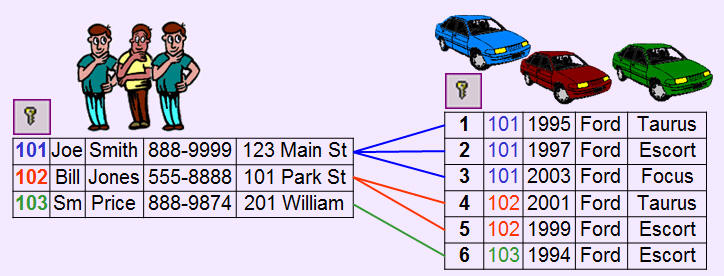
Ms Access Insert Foreign Key Value
Foreign key columns are frequently used in join criteria when the data from related tables is combined in queries by matching the column or columns in the foreign key constraint of one table with the primary or unique key column or columns in the other table. An index enables the Database Engine to quickly find related data in the foreign key. Jul 21, 2011 Need to create foreign key in MS Access Plesae help! I am building a relational database with 2 main tables that should relate in a one to many relationship. I have gone to the design tab created relationship, done the join but cannot enforce referential integrity.
SQL Server 2016 (13.x) increases the limit for the number of other table and columns that can reference columns in a single table (incoming references), from 253 to 10,000. (Requires at least 130 compatibility level.) The increase has the following restrictions:.Greater than 253 foreign key references are supported for DELETE and UPDATE DML operations. MERGE operations are not supported.A table with a foreign key reference to itself is still limited to 253 foreign key references.Greater than 253 foreign key references are not currently available for columnstore indexes, memory-optimized tables, or Stretch Database.FOREIGN KEY constraints are not enforced on temporary tables.If a foreign key is defined on a CLR user-defined type column, the implementation of the type must support binary ordering. For more information, see.A column of type varchar(max) can participate in a FOREIGN KEY constraint only if the primary key it references is also defined as type varchar(max).PermissionsCreating a new table with a foreign key requires CREATE TABLE permission in the database and ALTER permission on the schema in which the table is being created.Creating a foreign key in an existing table requires ALTER permission on the table.