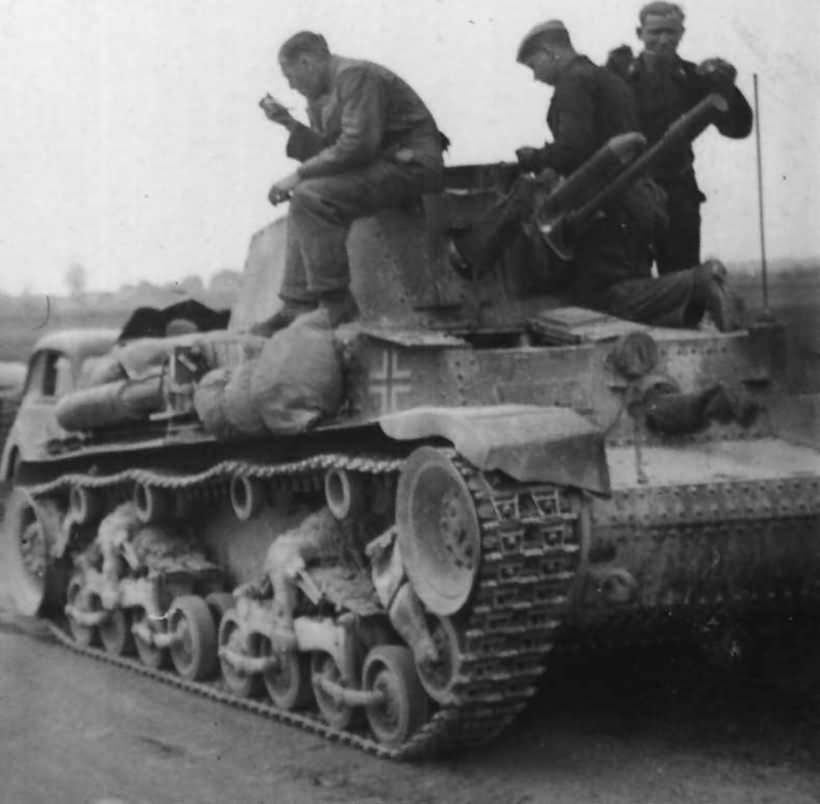
1/56 (28mm) Panzer 35(t) LT vz. 35 R-2 Czechoslovakian designed tank that saw service with many of the Axis powers. In its original Czechoslovakian service it was known as the LT vz. Germany used the tank to bolster their tank forces during the Battle of France and during the early phases of Operation Barbarossa. In 1942 Germany sold their remaining Panzer 35(t) stockpile to their allies. More about the Panzer 35(t) tank. The Panzer 35(t)-page contains all related products, articles, books, walkarounds and plastic scale modeling projects dedicated this vehicle. This topic is categorised under: Vehicles » Tanks » Panzer 35(t) Join us now! 30.000+ plastic modelers use us.

Operationalrange120 km (75 mi) or 190 km (120 mi)Speed34 km/h (21 mph)The Panzerkampfwagen 35(t), commonly shortened to Panzer 35(t) or abbreviated as Pz.Kpfw. 35(t), was a -designed used mainly by during. The letter (t) stood for tschechisch (German: 'Czech').
In Czechoslovak service, it had the formal designation Lehký tank vzor 35 (Light Tank Model 35), but was commonly referred to as the LT vz. 35 or LT-35.A total of 434 were built; of these, the Germans seized 244 when they and the acquired 52 when they declared independence from Czechoslovakia at the same time.
Others were exported to. In German service, it saw combat during the early years of World War II, notably the, the and before being retired or sold off in 1942. It was used for the remainder of the war by other countries and as a training tank in Bulgaria into the 1950s. Contents.Description The Panzerkampfwagen 35(t) was assembled from a framework of steel 'angle iron' beams to which the armour plates were riveted. A 4 mm (0.16 in) separated the engine compartment from the crew.
It had several mesh-covered openings to allow access to the engine and improve ventilation by drawing air in through the commander's hatch. This had the advantage of rapidly dispersing gun combustion gases when firing, but several disadvantages. The constant draft generated by the engine greatly affected the crew during cold weather, the danger of an engine fire reaching the crew compartment was increased and the engine noise and heat increased crew fatigue.The driver sat on the right side of the tank using a 390 by 90 millimetres (15.4 in × 3.5 in) observation port protected by 50 millimetres (2.0 in) of and an armoured shutter 28 millimetres (1.1 in) thick. To his right was a vision slit 120 by 3 millimetres (4.72 in × 0.12 in) with a similar thickness of bulletproof glass. The Germans replaced the original three colored lights used by the Czechs to communicate with the driver with an intercom system. The radio operator sat on the left and had his own 150 by 75 millimetres (5.9 in × 3.0 in) observation port with the same protection as the driver's. His radios were mounted on the left wall of the hull.
The hull machine gun was between the driver and radio operator in a ball mount capable of 30° of traverse, 25° of elevation and depressing up to 10°. Most of the machine gun's barrel protruded from the mount and was protected by an armoured trough. The mount had a spotting telescope, but open sights could be used if the plug at the top of the ball mount was removed. If necessary, the driver could lock the mount into position and fire it himself using a. The driver's hatch was exposed to direct fire and could be damaged from the front.The turret ring had a diameter of 1.267 metres (49.9 in). The turret had a flat face in the center of which was mounted the 3.72 centimetres (1.46 in) main armament.
On the right side was another 7.92 millimetres (0.312 in) machine gun in a ball mount. The commander had four episcopes in his cupola and a monocular mirror, 1.3 x 30° periscope which he could extend, once he had removed its armoured cover in his hatch, to give vision while 'buttoned-up'. As the sole occupant of the turret, the commander was responsible for loading, aiming and firing the main gun and the turret machine gun while simultaneously commanding the tank. The Germans added an extra crewman on the right side of the turret to load the main gun and to operate the turret machine gun. Some ammunition had to be removed to accommodate him.The 8.62-litre (526 cu in) Škoda T-11/0 four-cylinder, water-cooled produced 120 horsepower (89 kW) at 1,800 rpm. Two fuel tanks were fitted, the main tank with a capacity of 124 litres (33 US gal) was on the left side of the engine and the 29 litres (7.7 US gal) auxiliary tank was on the other side.
The engine could run on gasoline, an alcohol-gasoline mixture, and 'Dynalkohol' (an alcohol- mixture). It was mounted in the rear along with the six-speed transmission which drove rear-mounted drive sprockets. The suspension was derived from the tank; eight small pairs of road wheels on four per side, each pair of bogies sprung by a single, a front idler wheel, and four track return wheels.
An unsprung road wheel was located directly underneath the idler wheel to improve obstacle crossing. The transmission, brakes and steering were mechanically assisted with compressed air, reducing driver fatigue. This last feature proved problematic in the extreme conditions of the. Panzer 35(t) in France, 1940In 1939, following the in March 1939, 244 vehicles of the Czechoslovak Army were seized by the Germans where they were known as the L.T.M.35 until January 1940. In German service, they were used as substitutes for the medium tank. They were assigned to the Panzer Battalion (Panzerabteilung) 65 (39) of the and the independent Panzer-Regiment 11 (81) where they participated in the.
Panzer 1
77 of these were lost during the campaign, mostly due to mechanical breakdowns, but only 7 of these were irreparable. From 1940 on, there had not been any spare parts available and tanks had to be completely rebuilt to remain operational. The 1st Light Division absorbed the 11th Panzer Regiment and was redesignated as the on 18 October 1939. It took 132 Pz.Kpfw. 35(t)s into the where it was assigned to for Panzergruppe von Kleist 's attack through the.
44 of these had been lost by the end of May. 35 replacements were issued on 3 June in preparation for, the attack on the remnants of the French Army that began the following day. A total of 62 Pz.Kpfw.
35(t)s were either total write-offs or were damaged beyond the ability of the field maintenance workshops to repair during the campaign. PzKpfw 35(t) in the USSRFor, 6th Panzer Division had 160 Pz.Kpfw. To support 's drive on. By 10 September 1941, the division had only 102 operational Pz.Kpfw. 35(t), despite having received two replacements from Germany. Eight tanks were repairable, but 47 were total losses. By 31 October, only 34 were operational with another 41 requiring repair.
On 30 November, all Pz.Kpfw. 35(t)s were reported non-operational.The average distance driven is 12,500 kilometres (7,800 mi) for the Pz.Kpfw. The special situation in regard to repair the Pz.Kpfw. 35(t) is well known. It is indeed deemed necessary to point out that repairs can only be accomplished by cannibalizing other Panzers because there are no longer any spare parts for the Pz.Kpfw. This means that after retrieval of the Panzers that are scattered around the terrain, a maximum of 10 can actually be repaired out of the 41 Pz.Kpfw.
35(t) reported as needing repair. 35(t) can no longer be rebuilt. All of the components are worn out. To be practical, maybe the armored hulls are still useable. R-2 tanks in February 1939, before being delivered to Romania byRomania ordered 126 of the tanks on 14 August 1936 as the R-2 and received the first 15, which had been diverted from the Czech order, in April–May 1937 to display in a parade. They suffered from numerous teething problems and the Romanians put a hold on production until these issues were resolved. The constantly changing Romanian demands didn't help the situation, but they refused to accept any vehicles until trials were conducted in Romania.
Three R-2s were shipped to Romania on 12 July 1938 for the trials, but Skoda knew which one would be chosen and prepared the vehicle well and it passed all tests. After disassembly and checks of the trial tank were completed, the Romanian commission approved the design on 23 August. In the meantime, the initial batch was returned to Skoda to be upgraded to current standards on 28 July. Shipments to Romania began on 1 September with 27 shipped before the Munich Crisis forced the Czechs to hold all remaining tanks in case they were needed. 5 finished tanks and six almost-finished tanks were appropriated and shipped to Slovakia although they were quickly returned after the was signed. The last shipment departed on 22 February 1939.The R-2s were assigned to the 1st Armoured Regiment of the 1st Armoured Division where they participated in Operation Barbarossa. The division was withdrawn from combat after the in 1941.
At the start of 1942, 40 tanks were sent to for overhaul while 50 more were repaired in. The division returned to the front on 29 August 1942 with 109 R-2s. By the eve of the Soviet on 19 November the division could only muster 84 serviceable R-2s with as many as 37 unserviceable tanks stationed in the rear. The division was on the outer edges of the Stalingrad Pocket, but managed to break through the western wing of the encirclement, although 77 R-2s were lost in the process. Only about a third of these were destroyed by the Soviets, the rest were either abandoned or broke down and couldn't be recovered.
One R-2 arrived from Romania during December as a reinforcement. The 1st Armored Division was ordered home in early January 1943.Despite the delivery of 26 Pz.Kpfw.
35(t)s during 1942, Romania could only muster 59 R-2/Pz.Kpfw. 35(t)s on 1 April and 30 August 1943, but raised this to 63 by 25 March 1944. There were 44 on hand on 19 July 1944.
By this time they were relegated to training duties with the 1st Training Armoured Division. A company of R-2s was sent to with the ad-hoc Cantemir Mixed Tank Group on 24 February 1944, but it did not see combat before being withdrawn on 28 March 1944.A company of R-2s was assigned to the Popescu Armoured Detachment after and Romanian's defection from the Axis at the end of August 1944. The Detachment was tasked with preventing the German units stationed around from breaking out to the north and finding refuge in Hungary. They accomplished their task and the R-2s were withdrawn from combat operations until the following year. Romania had concentrated all of its remaining tanks and armoured fighting vehicles in the 2nd Armoured Regiment in early 1945 as the unofficial Soviet arms embargo began to have effect. It had five R-2s on hand in early February 1945 when it was sent to the front, but the Soviets confiscated most of them when it arrived. Both R-2s were serviceable when the regiment entered on 4 April 1945, but these were probably destroyed when the regiment was nearly surrounded in Austria on 10 April because they are no longer listed among the regiment's vehicles afterwards.Twenty-one tanks were rebuilt as tank destroyers with an ex-Soviet 76.2 mm gun in 1943–44.
Slovakia The Slovak Army seized 52 LT vz. 35 tanks when they declared their independence from Czechoslovakia in March 1939.
They were organized into a battalion that was later incorporated into the Armoured Regiment. Three of these tanks participated in the of March 1939. One tank company participated in the invasion of Poland, but didn't see any fighting. The Army upgraded the internal communications system of its tanks with German intercoms in 1941, but it is unknown if they added a fourth crewman as did the Germans. When Slovakia joined the German it sent a Mobile Group that included thirty LT vz.
The Mobile Group was reinforced and reorganized in early July 1941 as the Mobile Brigade, also known as Brigade Pilfousek after its commander, and it mustered only twenty seven tanks despite seven reinforcements because breakdowns had caused ten to be evacuated back to Slovakia. This was due to a conspiracy among the Slovak tankers that the tanks would be needed to overthrow the regime at some point and couldn't be wasted in combat against the Soviets. This caused a high incidence of crew sabotage to which the officers and maintainers turned a blind eye, which caused the tanks to be withdrawn to Slovakia at the beginning of August 1941.
On 1 January 1942, the Slovaks had 49 LT vz. 35 on hand because three had been destroyed in the battle for Lipovec earlier in the summer. However, of these 49 only seven were operational as part of the conspiracy to keep the tanks in Slovakia The LT vz. 35s were relegated to the training/reserve role by 1943 when the Germans began to supply more modern tanks to Slovakia. At least eight LT vz.
35s were used by the insurgents during the in 1944. Bulgaria.
Bulgarian T-11 with A-3 gunin Sofia, December 1944used 26 tanks, delivered by Germany from used war reserve stock in early 1940, with the normal A-3 gun and 10 New T-11 tanks with the more powerful A-7 gun from the confiscated Afghan order were delivered between August and October 1940. They equipped the 1st and 2nd companies of the Bulgarian armored regiment in June 1941. They were supposedly relegated to training duties once the Germans began to deliver medium tanks in 1944, but apparently remained in service into the Fifties.

But Kliment and Francev claim that the T-11s participated in the fighting in Yugoslavia and ended the war south of as part of the 1st Tank Brigade. 35 captured in Carpatho-Ukraine by Hungarian armyHungary captured one LT vz. 34 in on 15 March 1939, when it conquered that country, and also a LT vz.
Lt Vz. 34
35 in fighting with the Czech demonstration detachment returning from Kubinka in med-March 1939. They were impressed and asked Škoda for a quote to repair them. The Hungarians did not accept the price, but Škoda fixed them for free once the Hungarians had bought a license to build the medium tank in August 1940. The tanks were returned to Hungary in March 1941 and were used for training through 1943. See also.
Click to expand.I'd argue that the M4 had far more design elements in common with modern tanks than the t-34Sloped front armor, straight side armor, stabilized gun, fully powered turret for fine tuning (in t-34 you had to handcrank for fine tuning while power traverse was too imprecise to do anything but rough laying) wet stowage, modern rubberpad track design, etc.Its failing was the engine mounting which required the hull to be tall. It was however the best vehicle to actually live and fight in from a crew comfort and safety perspective by leaps and bounds during the war, something that was noted as an important feature in post-war design. Sloped Armor reduces the amount of useable interior volume. Most gear was more like boxes than triangles, only fuel tanks can be conformal, and putting fuel tanks in the hull sides and sponsons of the fighting compartment is not great idea.Some one else, from other post, and 'oh my god, the tank is on fire' is searchable.3.
The track life of the M4 exceeded the engine life on the T-34. There's a reason why the Soviet Red Guard units were equipped with LL Shermans for exploitation. Look up Dmitriy Loza and Commanding the Red Army's Sherman Tanks. Click to expand.Yeah I think if Britain said they would back Czechoslovakia and France said 'Ok, and we'll give some ammo for Britain while they pay with blood to stop German aggression and pass the popcorn' the Wehrmacht officers after a month of banging into the enemy forts with their 1938 tech (before the addition of Czechoslovakian tech to their mix) would be plotting to get rid of the Mustached corporal who got them into the mess.Well, Let's say TTL Panzer III use German optics and electronics. This fixes the 'optics and radio' flaws. Bad workmanship and lack of standardization should also be fixed. So TTL Panzer III wouldn't inherit those claws, although it would inherit a two man turret.I disagree with your under gunned thing since AP shells still had greater penetration than the OTL Panzer III's weapons.
It could even penetrate itself at 1 km, if it could hit accurately that far. And the T-34 could reach its paper speed in flat places when it wasn't too hot. Plus TTL Panzer III has a good diesel engine and much less weight. Click to expand.Sticking with either a 75 mm or 76 mm for anti-tank purposes in this scenario, don't question it. You can say some engineers looked at drawings of designs and then submitted design suggestions.
Hitler's whim often overrode any coordinated planning so any arbitrary design could be accepted in an early POD. So a 75 mm gun with lower muzzle velocity than a 50 mm gun could end up in a design.The Panzer III was designed for one job: destroy armored enemy vehicles. That would be the case OTL and TTL. I guess TTL Panzer III would be the 'diesel engine large gun anti-tank panzer' and the Panzer IV would be 'the anti-tank Panzer where we get the joys of elbow room instead of tunnel vision'. I'd argue that the M4 had far more design elements in common with modern tanks than the t-34Sloped front armor, straight side armor, stabilized gun, fully powered turret for fine tuning (in t-34 you had to handcrank for fine tuning while power traverse was too imprecise to do anything but rough laying) wet stowage, modern rubberpad track design, etc.Its failing was the engine mounting which required the hull to be tall. It was however the best vehicle to actually live and fight in from a crew comfort and safety perspective by leaps and bounds during the war, something that was noted as an important feature in post-war design.
Panzer 4 For Sale
Click to expand.The Panzer 35(t) had one. And it was deemed an adequate Panzer III substitute before the 50 mm gun upgrades for the Panzer III.And really what's wrong with having one tank out of many designs be the oddball?Do you think when the 1940 battles open up the German crews might actually just end up suffering more losses due to the bad turret design and poor ergonomics? In OTL, most tank vs tank fighting happened in Belgium. Army Group A saw little of that after Sedan since many French mobile units originally designed to be in reserves were in Belgium racing towards Breda. Click to expand.1: 35(t) was taken into service because they were there and could be made with no setup. It was a vastly inferior tank to what the germans had but the germans didn't have many tanks so they took what they could get.2: Because the germans were right about what constituted an effective tank and what was required to make it effective and they made damn sure that any tank that they themselves designed would run paralell to these lines.
They had odd ideas about overengineering and logistics but they were spot on when it came to crew workload and ergonomics for the most part.3: Yes, definitly, as evidenced in poland, france and russia being able to spot and service a target fast is paramount in any tactical engagement. This improved tank survivability massively against any opponent, not just tanks, but against AT guns and infantry as well. Click to expand.This is a very specific case unique to the IS tank's peculiar hull 'superstructure'. If you have a block of wood with a certain area on the bottom and want to bevel the top edges, you're going to have to mill those parts off and therefore reduce the volume. The volume only stays constant if you increase the dimensions of the block.The early T-34 was a legitimately bad tank. Comparing armor values and penetration capabilities gets a fairly even match with the Pz III. These vehicles were roughly at the first-look, first-shot, first-kill equilibrium point, so the Pz III's far superior tactical attributes - 3 man crew, better optics, radios, better visibility - made it a superior tank to the early T-34 variants.
Click to expand.Ummm, that was the case OTL.But why here? Effectively TTL Panzer III would be a T-34 with less armor, but better optics and electronics. In this situation, both the T-34 and panzer III could destroy a T-34 at ranges longer than the effective range of their opticsAnd they would still have their TTL Panzer IVIn TTL they have a tank with either a clone of the same 76 mm gun (which can penetrate the T-34 at the front at one Km.
Ironically using German optics might make TTL Panzer III able to engage at longer ranges than T-34 with its bad optics unable to actually acquire targets from far away) or a Czechoslovakian 75 mm gun that works at least as well. So their two main tank vs tank panzer would the Panzer III (able to take on the T-34 at long range, good speed, good sightings, but problematic tunnel vision and bad turret design), and Panzer IV (3 man turret, better situational awareness, less breakdowns, but weaker 5 cm KwK 38. What if the Germans did what the US did with self propelled anti-tank vehicles but earlier? Below is a pic of the 75mmselbstfahrlafette L/40.8 an experimental anti-tank vehicle.What if the Germans had gotten this idea a few years earlier but had mounted the turret on the Pz-III instead and used the Czech that they had captured in good numbers in 1938? This would've given the Panzerwaffe a TD similar to the US M18 Hellcat in 1940.The tank's turret armour would be lighter but would have a more powerful and longer ranged gun.Below my take on what this TD could've looked like.